Premium Grayed: William Kentridge’s Monochromatic Riches
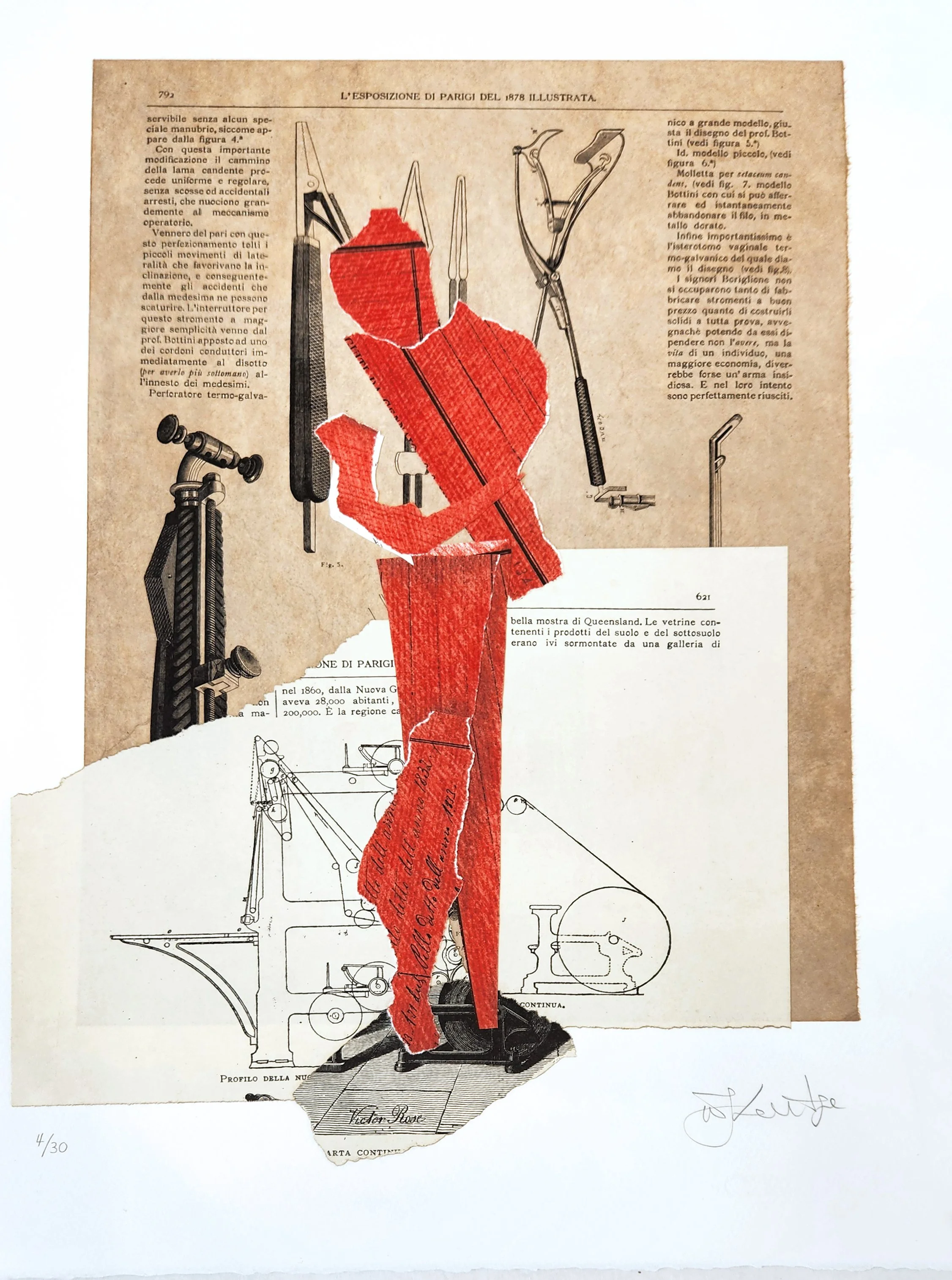
William Kentridge, “Questa Importante Modificazione” (Gallery Neptune & Brown)
Mar 11, 2026
A VAGUELY HUMAN FIGURE MADE OF SCARLET SCRAPS centers “Questa Importante Modificazione,” a collage-print that’s one of the attention-getting pieces in William Kentridge’s “Vertical Thinking.” While that red is the only bright color in the Gallery Neptune & Brown show, luxuriant hues are hardly lacking in this selection of prints, drawings, and collages from 1993 to 2024. The veteran South African artist is a master of grays. Such prints as the three-panel “Medicine Chest” supply a rainbow of middle tones, seemingly layered like pencil marks.
Regular visitors to Neptune & Brown, which often exhibits Kentridge’s work, will recognize familiar motifs. The artist likes angular metal coffeepots so much that he sometimes substitutes them for people’s heads. (He also may streamline heads merely to gargantuan noses.) He’s long riffed on proto-Dadaist Alfred Jarry’s 1896 play, Ubu Roi, which flavors “Dada Picnic,” a parade of people whose figures demonstrate varying degrees of abstraction. His homeland’s fraught history is layered into the mix of “Landscape,” one of his many drawings executed on 1913 Rand Mines ledger sheets.
Although nearly all these pictures are black-and-white, their styles are diverse. Such hand-colored prints as “LULU (Portrait of a Lady Looking Down)” are high-contrast, softened by light-gray shadows. Much more detailed, “The General” is a stark lampoon of evil authority inspired both by early 20th-century European caricaturists and the brutality of apartheid’s enforcers. The solid black forms in “Chairs from Zeno II” are silhouetted like shadow puppets, while the ones in “Planes from Zeno II” are distant and suspended among wispy scratches. (”Zeno” is a reference to a play based on Italo Svevo’s 1923 novel, Confessions of Zeno.)
Kentridge’s pictures refer not only to theater but also to short animated films he’s made with such collaborators as Deborah Bell (one of whose large drawings is included in this show). But his prints and drawings are not subsidiary to his work in other media. They stand alone, exquisitely detailed and sumptuously monochromatic.