East City Art Reviews—William Kentridge Vertical Thinking at gallery neptune & brown
By Claudia Rousseau, Ph.D. on February 25 2026
A selection of prints by the South African polymath artist William Kentridge is on view at gallery neptune & brown. The group includes works from various series (the artist tends to work in series) dating from 1993 to 2024. Primarily in black and white, many with collage, one of the most interesting aspects of the group is the variety of sources that the imagery references reflecting Kentridge’s interest in art history.
To get an idea of the artist’s roots in art history I recommend watching a video online in which Kentridge comes into the studio with a long wooden pointer and begins to discuss a poster reproduction of Philip Guston’s 1969 painting, The Studio.[1] Apart from his disarmingly simple professorial manner, what was most striking about it was the way Kentridge employs a large group of black and white photos of works of older art as comparisons to demonstrate Guston’s artistic influences, considerably enlarged when he returned to figuration. Kentridge’s 8-minute discussion provides insight into his understanding of his connection to the older artist. As the Guston work shows the artist painting a self-portrait wearing the white hood, with all of its social and historical implications, it becomes evident that Kentridge feels an affinity to an artist who used his art to express more than his emotions, but also hard political realities and as a way to mock the ultimate banality of evil. Moreover, the video shows that Kentridge, like Guston, possesses a clear inclination to pull from the vast repertoire of art history in his work.
In looking at the current exhibition, it was this aspect of these prints from three decades of the artist’s varied career that stood out. For example, there is the “nose” series represented here with two delightful examples.
Nose with Mustache on a Horse shows a figure riding a prancing horse, but with a nose replacing his head, freely painted in black. Collaged dictionary and other clippings in English and Russian seem to have been chosen both for content and for the shape of the text. The figure holds what looks like a cell phone pouring out useless information. The “nose” has an indication of eyes and a spiral form in the collaged bit filling it that doubles as a mustache. A bird in the upper right suggests Surrealist thinking to which Kentridge has demonstrable connections.
When I first saw this print, I immediately thought of Salvador Dali. A relatively late painting by Dali, Le Nez (The Nose), 1952, features a large nose carried by an Atlas-like figure and a smaller one on a turning platform below it. There are a number of other works by Dali featuring the nose like his Napoléon’s Nose, 1945 recalling the symbolism of strength and ambition in an aquiline nose in ancient Rome, and Dematerialization Near the Nose of Nero, 1947, that referenced that emperor’s complete artistic cancellation, as well as all the broken noses on ancient Roman sculpture. And, of course, there were Dali’s 1950s black and white lithographs of Don Quixote on his horse. Dali himself had a famous curling mustache which appeared in numerous photos of the artist, with the artist often twirling its ends.
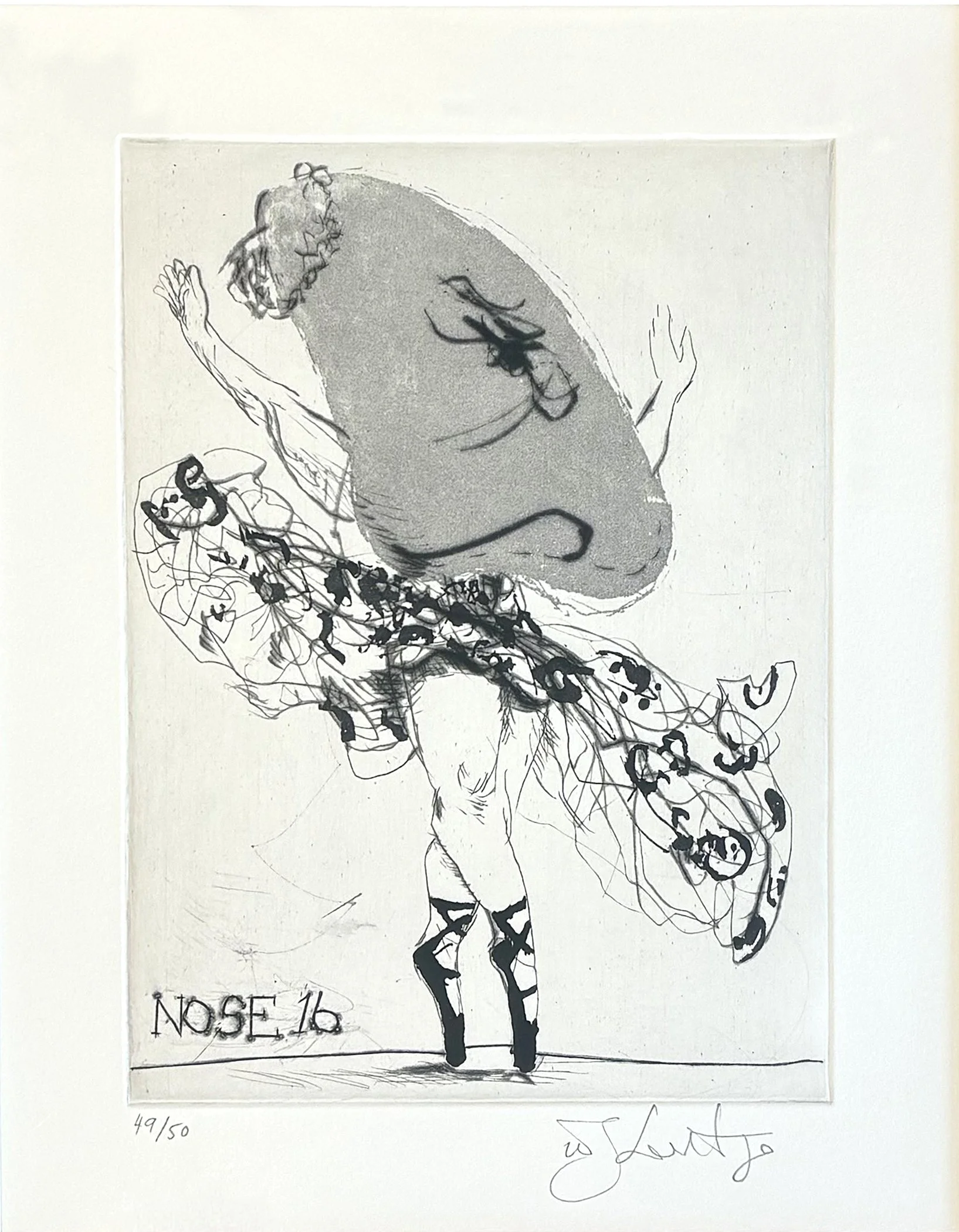
In Nose 16 (Angelina Ballerina) the entire upper body of the dancer, save her arms, is a textured nose wearing a little flower crown. Again there are indications of facial features on the nose, including a curling line that could be a nostril or a mouth. Her tutu is made of meandering lines and squiggles that the viewer can read as billowing tulle. The image is both hilarious and frightening, especially if you imagine the nose being a hood clamped over the ballerina’s head while she’s made to dance en pointe.
The wavy and loopy line is a Kentridge trademark. In another online video he draws that line with a crayon behind his back. It appears in all kinds of works including two prints in this group that stand out: one of four photogravures drawn from his six piece film series Studio Life and another from his print series Lexicon.
Studio Life: Laocoön provides a view into the artist’s studio containing a three-dimensional work made of looping and twisting lines of wood (?). A black painted echo of it appears to the left, and a thinner serpentine line snakes its way along the frontal plane, with a drawn bowl and glass. All this twisting and turning points to Kentridge’s title: Laocoön, of which the sculpture in the print is an echo.
The ancient work illustrated above was a sensation when it was pulled out of the ground in Michelangelo’s presence in Rome in 1506. Its twisting and struggling figures continued to inspire artists for centuries, including William Kentridge.
Kentridge appears to love illustrated dictionaries, so a series titled Lexicon is not unexpected. Medicine Chest, a print from this series, is in this show. Here objects appear in three categories as though on shelves, and the waving meandering line appears behind the top one, plants, and behind the second, bottles. The bottom features things that make sound with lines suggesting volume. A drawn lamp above them is straight out of Picasso’s Guernica.
And then there are the Italian coffee pot self-portraits. Kentridge has a particular fondness for the ubiquitous moka express stovetop coffee pot made famous by Bialetti in Italy since the 1930s. It appears in numerous prints and drawings, often with the top part doubling (surrealistically) as a head on a human figure. In another online video featuring Kentridge talking about his studio practice, the artist remarks that he could have done a “self-portrait” as many things, but it was the coffee pot that he chose. For example, a press release for Listen to the Echo, a double exhibit mounted in two museums in Germany in 2025 to celebrate Kentridge’s 70th birthday, featured a drawing titled I Look in the Mirror/ I Know What I Need from 2024. In the drawing two male figures with coffee pot heads seem to be in a mock fight. They wear what might be partial waiters’ outfits: black pants, white shirts and dickies of a standing collar with bow ties. Somehow these represent the artist’s inner struggle with himself. The idea of the echo or the double is frequent in Kentridge’s personal iconography, as well as repetition or recasting of parts of an image, a practice that recalls both Marcel Duchamp and Jasper Johns.
The neptune & brown gallery exhibit has a wonderful example in Self-Portrait as a Coffee Pot.
The print gives us a somewhat truncated idea of a figure, head is the Italian coffee pot, hands splayed out, a loudspeaker pumping out noise for a mid-section and feet painted on collaged materials. A black band reading “Self-Portrait as a Coffee Pot” in white letters points downward, and above the loudspeaker is something about a “talking clock” which might allude to the artist’s heart. In the upper left, on a clipping with illegible text, Kentridge writes: “The object & its unreliable witnesses”.
The combination of image and text here reminds me of the recurring objects and themes in Johns’ prints and paintings, but even more so of Duchamp. The reference to “unreliable witnesses” immediately made me think of Duchamp’s “oculist witnesses” in the Large Glass, that compendium of so many of his ideas.
Among the most recent works in the exhibit is a fascinating color lithograph titled in Italian, Questa importante modificazione (this important modification). The title is lifted directly from the upper left paragraph of the collaged text that is the main background of the work. The page comes from an Italian language review of an industrial exhibition held in Paris in 1878. The sentence goes on to say that “…with this important modification, the path of the falling blade proceeds in a uniform and regular way without the shocks or accidental stops that seriously harm the mechanism”.[2] There are drawn illustrations of the instruments described in the text and another page with a whitened background has a wonderful illustration of some kind of machine. Above it is an orange figure collaged in pieces that seems to be parading to the right.
The famed art critic John Berger once suggested that “the metaphorical model of Cubism is the [mechanical] diagram.”[3] The concept of this print reminded me of Cubist collages in general, but especially of the works of Juan Gris and Francis Picabia such as Parade Amoureuse by the latter where the mechanical represents a love parade. One can also think of the narrative of Duchamp’s Large Glass, again referring to mechanized sexuality. Kentridge’s collage/lithograph has a definitive Dada feeling, as do the coffee pot portraits, but his take is more tongue-in-cheek and more aesthetically positive.
All in all, I highly recommend the current exhibit that brings together so many truly fine works by this exceptional living artist, demonstrating many of his interests and influences.
William Kentridge : Vertical Thinking. Editions from 1993 – 2024, gallery neptune & brown, February 7 – March 21, 2026; 1530 14th St NW, Washington, DC 20005. Wed.-Sat. 12-7 pm, https://www.galleryneptunebrown.com/
[1] https://www.youtube.com/watch?v=w_0aNAv2L-k
[2] My translations.
[3] John Berger, “The Moment of Cubism” in The Moment of Cubism and Other Essays, New York, Pantheon, 1969, p. 20: “The metaphorical model of Cubism is the diagram: The diagram being a visible symbolic representation of invisible processes, forces, structures. A diagram need not eschew certain aspects of appearance, but these too will be treated as signs not as imitations or recreations”