
Remembering Maine
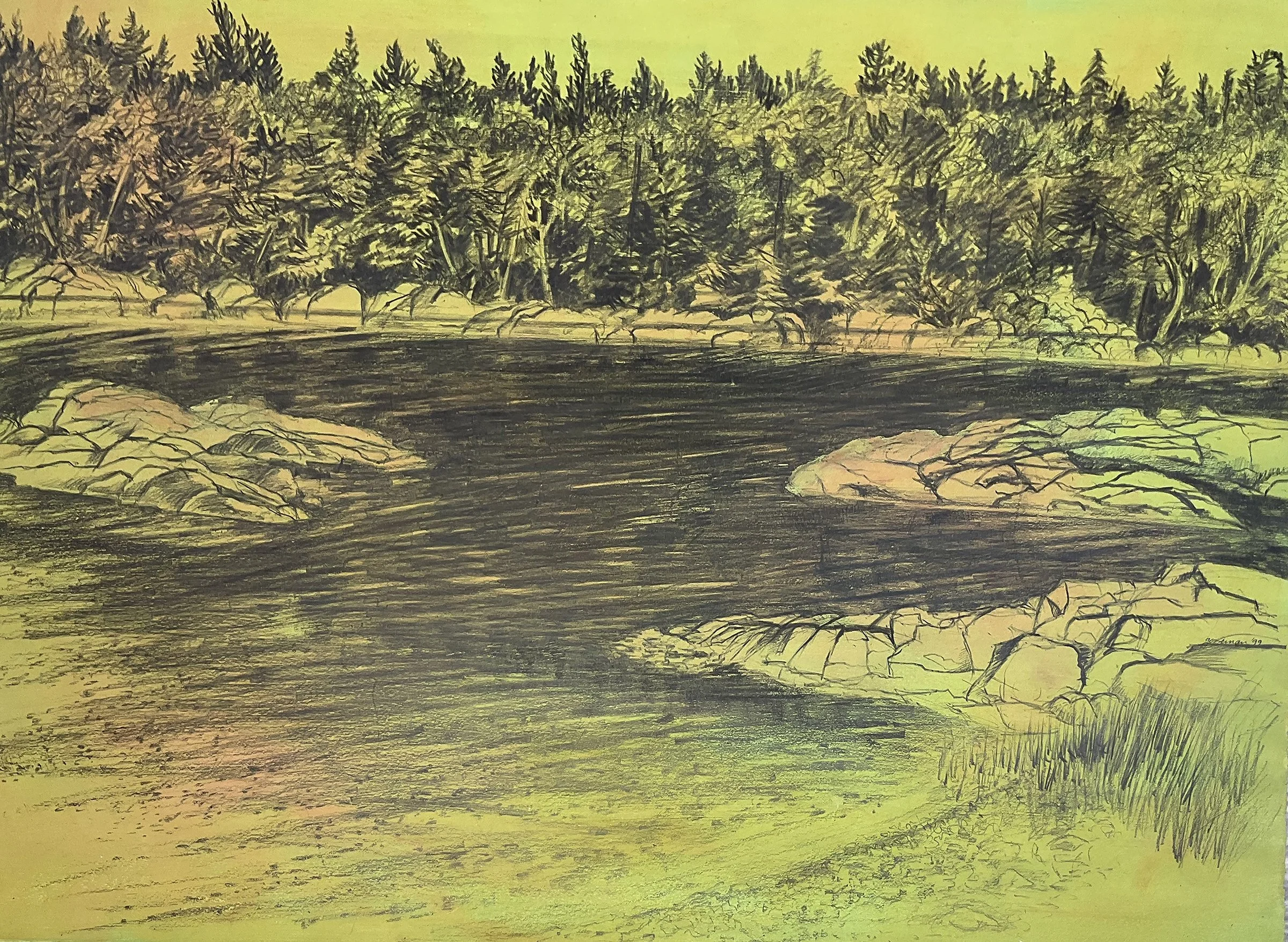
TWO SEPARATE SHOWS OFFER MORE THAN TWINNED VIEWS of Deer Island, Maine, local artist Janis Goodman’s summer home for 25 years. At the American University Museum, “Where Water Keeps Time: Graphite Drawings by Janis Goodman” depicts the rustic area entirely in gray, black, and -- sometimes most powerfully -- the absence of tone altogether. At Gallery Neptune & Brown, “Coastal Reverie” adds oil and watercolor paint as well as colored pencil.
In recent years, Goodman has most often shown luminous, cloud-filled skyscapes that flirt with abstraction even though their style is rooted in neoclassical painting. There’s one of those in the Neptune & Brown selection, but most of the pictures in both shows depict recognizable phenomena. The sky painting is, as usual, a tondo. Some of the drawings are also round, although sometimes with an element outside the circle, such as the many birds (and a lone seal) in several pictures at AU. The effect is graphically dynamic, and calls attention to the limitations of artistic representation -- real life overflows the neat borders of any vignette.
Goodman’s work can be quite detailed, but she’s an expert judge of what should be excluded from a composition. The AU pieces banish color, of course, and often place thickets of pencil lines on white fields. One of the loveliest pictures in this array, which was curated by Laura Coyle, is “Afternoon Reflection,” a view of rippling water below a distant stand of black trees. Every pencil stroke is deployed to frame the unmarked areas that are the essence of the picture, yet would be simply blank space without the gray gestures that define them.
Less unified but no less compelling, the Neptune & Brown show includes oil paintings that amplify the artist’s pencil closeups of ripples and eddies with color and textural effects. It also includes some gray-heavy graphite drawings in the same mode as the AU ones, and pictures that overlay watercolor tints atop pencil renderings. Most are rectangular, but a few are contained within Goodman’s trademark circles. The shape evokes the planet she stands on, and the orb that illuminates her summertime refuge in the silky-gray “Moon Over Cove.” It also suggests the eye, the human facility that distills disconnected instants of light, sky, and water into an enduring vision.